Showing posts with label Review. Show all posts

Thursday, March 01, 2007

The End of Mr. Y

I'm sitting here looking at a copy f Deborah Eisenberg's Twilight of the Superheroes, and wondering if I should start it. The reason for my hesitation, is the mental fatigue from finishing the last book that I read. The book in question is The End of Mr. Y by Scarlett Thomas.

The End of Mr. Y is about a book, a curse, and a woman. There is also a smattering of mice. We will get to the mice later.

Ariel Manto is a PhD student who has developed an fascination for a book. A book written by an obscure 19th century author, a book which is rumored to be cursed. Then one day Ariel goes into a second-hand bookshop and finds the book.

Disregarding the curse, Ariel begins to read The End of Mr. Y which inevitably leads her down a drug-induced rabbit-hole into a world called the Troposphere. In the Troposphere, Ariel learns the ability to enter the mind via a simulation much like a computer game.

Her first trip through the mind of her neighbor, two mice, and a cat, leads Ariel to question her own sanity. However, when two sinister men appear on the scene threatening her life, and looking for the book, Ariel realizes that she has come upon something that is frighteningly real.

The narrative flies along at a break-neck speed as Ariel tries to resolve the mystery of the book, the Troposphere, and why she is being hunted down. In the process of her flight, she learns how to travel through human thoughts, and meets the god of Mice.

Depending on your taste and interpretation, the plot of The End of Mr. Y can be perceived as intriguing, trippy, or ludicrous. One librarythinger even tagged the book as chick-lit. I guess when the collective female population decides to stop worrying about our weight, start chatting about philosophy, and begin to cut ourselves to feel alive, then maybe we can call this chick-lit. (I'm not saying that we don't already do this, I'm just saying that I don't consider this the sort of thing that you look for when you read chick-lit.) Trying to categorize this book will make your head hurt. If you haven't read it, then don't believe anything anyone tells you about this novel. You can't define this book with catch-phrases. And if you are looking for comfort, you will not find it between these pages.

The greatest thing about the novel, aside from its ideas on philosophy, science, and theology, is the main character.

Ms. Thomas creates a fully realized character in Ariel, one so convincing that for two-thirds of the book, I felt that Ariel and Ms. Thomas were one, and I was reading a journal rather than a novel. I found this feeling surprising due to the fantastical nature of the plot, but believe that it stands as evidence to the deftness of Ariel's characterization.

Ariel's character is defined by it's subtleties. Her aberrancy, like most people's, lay under the surface of her character, and allow her to be 3-dimensional. They give her depth, but because of their subtlety and complexity, allow her to escape generalizations. I found myself deeply engaged with her character throughout the novel.

The End of Mr. Y is the sort of book that asks you to question your beliefs of reality. In fact it may turn your world upside down with its many suggestions, and ideas. How you react to this will determine whether you enjoy this novel.

That is not to say that there weren't certain glitches along the way--- some of the conversations were lengthy and self-indulgent, and I found the ending to be a little too nicely wrapped up for my taste.

Still despite it's zany premise, and its narrative indulgence, The End of Mr. Y holds up amazing well under scrutiny as an entertaining and believable novel of ideas.

Wednesday, January 31, 2007

On Procrastination, and pondering what makes Notes On a Scandal 'literary'.

I am so behind on reviewing books, that I have rather developed a guilt complex towards it. One that makes me feel like hiding behind bushes, or creeping around with a paper bag on my head in case anyone recognizes how much of a procrastinator I am or want to remind me that I have several reviews on my to-do-list that have been there for quite a while.

The trick I think, for future reference, is not to actually claim that I'm going to do such and such until after I have done it. The trick is to not try to take on so many books that I want review, and then feel overwhelmed because really its been a month, and I can't remember exactly what I wanted to say except cliched things like "fantastic, a mixture of the [insert great literary author name] and [insert another great literary author]", etc.

Of course I promptly ignore my own advice, and decide, to in fact write a entry about my procrastination therefore calling attention to the fact that I haven't really written many reviews lately, and also in doing so, promise once again, that I will get those reviews written very very soon.

Which really brings me to the point of today's post, my thoughts on What Was She Thinking: [Notes On A Scandal] - Zoe Heller. As many of you know the novel was made into a movie starring Cate Blanchett and Judi Dench very recently. Those of you who are waiting to get your hands on the book after seeing the movie may be a little disappointed, since the book proves to be a very much watered-down version of what you see on screen.

In the novel, Judi Dench's character, Barbara is not so much a manipulative, controlling she-demon, as she is a pathetic middle-aged spinster who has very nasty and opinionated thoughts about most of the people in her life. While there were some lesbian undertones in her character towards Cate Blanchett's Sheba , I felt the book version of Barbara wanted what Sheba has: youth, beauty, people that adored her, and most essentially human companionship, more than a relationship with Sheba. The book is a study of loneliness, and the human desire to be loved and wanted by others.

Interestingly enough, Babara of the book reminds me distinctly of the character, Amelia, from Kate Atkinson's Case Histories. While Judi Dench's version of Babara can be horrifying to watch, the book Barbara inspires more feelings of pity than loathing. The book and movie differ in this aspect.

Having said that, I'm not so sure that I would prefer the book over the movie. I certainly think that the words 'literary thriller', as touted by the back cover, is a stretch.

While I had no problems with the book as it is written (it tells the story in a straightforward Bridget Jonesy type narrative), I'm not sure exactly why critics found this book stellar in comparison to others. Critics have made claims that this novel is an intense study of psychological and emotional complexity but half way through the novel, I began to wonder if I was reading the same book as those people.

Admittedly the novel does tackle taboo and slightly sinister issues, and yes it uses an unreliable narrative.

But that's it.

There seems very little that is complex about the story or how it is told once we figure out that Barbara is a shaky narrator with very delusional, and needy personality and that Sheba is just the self-absorbed counterpart who feeds on Babara's attention as Babara feeds on her.

Some critics have also mentioned that the novel is darkly comic, but I found this gives the reader a very warped sense of the story, unless we now count sarcasm in its most bitter form as comic. While the novel is an careful study of character, the story seems to function just as well on screen as it does in words. Certainly I felt the story (in the novel) was told just as simply if only more subtlety in comparison to the movie

Although I did not find this novel to be bad, I can not help but be disappointed with the critical assessment which lead me to believe that I was going to read a much better and more interesting novel than this. Overall a disappointment, especially considering the quality and inventiveness of the books that I have recently been reading.

Friday, January 12, 2007

Atonement and White Noise


I was in West Virginia this past weekend (it's an actual state, not western Virginia...you'd be surprised how many times I have to make this distinction). I went down with some friends for a quiet weekend in the woods. It turned out to be a very quiet weekend indeed, since rain and mud made most of the hiking and walking about that I had planned unappealing. However it was a great weekend for reading and pillaging my old bookshelves for books that I didn't even remember purchasing.

I also finished Atonement by Ian McEwan, a book that I now wish we had picked to read for our book group instead of White Noise. In every way, Atonement is the more appealing novel. It is easier to read and at the same time more substantive.

I guess, the disclaimer here is that I found White Noise to be stylistically interesting but ultimately unsatisfying as a novel. To me, White Noise would've been more effective as a short story or novella. I felt that the central ideas and themes were too thin to justify the entire book. Certainly, the first half of the novel gave ample space to Delillo's exploration of 'rampant consumerism', 'media saturation' and other central themes. By the time we reach the end, the novelty and repetitiveness of his technique has long worn off, leaving the reader somewhat bored, apathetic, if not a little at a loss for words.

Atonement on the other hand, is a well-crafted if complex novel set before, during, and after Word War II. The story centers around 13-year-old Briony Tallis and the crime that she commits unwittingly one summer day on her parents' estate. The crime and it's repercussions haunt Briony through World War II, and into the final years of the 20th century. Atonement is a heartbreaking novel that examines themes of class, war, regret and guilt. (I spent the last half of the book intermittently weeping and trying to convince David that I was fine.)

While Atonement is a tragic book, it is not oppressively so. The plot is excellent, and while I have my own opinions about the alleged plagiarism of Lucilla Andrews' autobiography No Time for Romance in the latter half of the book---no one should be able to lift passages from someone's else's book almost verbatim without giving proper credit to the original--- it does not make me think any less of the merit of Atonement.

With or without those plagiarized passages, Atonement is a fantastic novel, one that I would highly recommend to anyone.

Sunday, December 17, 2006

Discovering Elizabeth Costello

I'm reading J.M. Coetzee's Elizabeth Costello at the moment. It's no wonder that he is considered one of the greatest writers alive. While I hold little stock in general pronouncements of this nature, Coetzee's mastery of language and expression would, I imagine, make any novelist slightly envious. I'm fascinated by the book, especially the way the Mr. Coetzee examines the life of this particular writer, Elizabeth Costello. The writing is concise yet eloquent, and proves that intelligent and masterful does not always mean difficult and inaccessible. It's this sort of book that makes me elated that I can read the English language.

Elizabeth Costello is a hard book to describe. It is grouped together into eight chapters, called "Lessons". Each chapter tells an set of events that happen in the life of an Australian writer named Elizabeth Costello. Some have said that the books is closer to philosophy than fiction. The books describes actions and events framed around rhetoric pieces in which characters define and explore the "African Novel", the "Lives of Animals", and so on. The rhetoric pieces, usually speeches delivered to an audience, are perhaps what makes some people categorize this novel as philosophy. I find this somewhat of a useless categorization. Certainly, Coetzee philosophizes; but he does so in the voice of his characters---flawed, often rambling philosophizing that not only shares ideas, but the inner workings of the characters themselves. This gives a frame of reference, so that we may study the ideas through the characters rather than in vaccum.

This is my first experience with Coetzee, I can not say for sure whether much of this text is autobiographical in nature. To me this seems to be a slight question in comparison to the ones posed in the text.

Now I crawl back into my hole to explore the book.

Friday, December 01, 2006

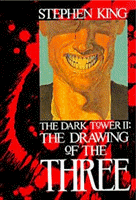
Waste of Time: The Drawing of The Three

I have just finished The Drawing of The Three by Stephen King, and I have to confess, I am deeply disappointed. To give brief background, The Dark Tower is Stephen King's dark fantasy series about a knight's quest to the Dark Tower in a world that has moved on. The tale is inspired by Robert Browning's famous poem "Childe Roland to the Dark Tower Came". Anyone who is interested in the series should read and study the poem, because it provide clues to what kind of story King is trying to tell. Stephen King claims that the series is his magnum opus.

In The Drawing of The Three, the second of seven novels, Roland, from The Gunslinger, makes preparationgs for his journey to the Dark Tower. While there are only very brief references in The Gunslinger, we are led to believe, that somehow there is a connection between Roland's world and our own. In The Drawing of the Three, we find that the connection is fleshed out. Roland is given three doors, all leading to different times periods in our world, to "draw" his companions for his trip. Much of what happens in the rest of the book takes place in our world.

Now for my reactions. I felt that the book was tediously longwinded. The story can be summed up in a paragraph, but took more than 400 pages to tell. Worst of all, the majority of those pages were not enjoyable reading material.

While King spent an surprising amount of time fleshing out the new characters, I felt that they were not only ill conceived, but less than believable. King's strong point has always been creating interesting and unforgettable characters that are believable as human beings. Without that, many of his horror stories could not have the impact that they do. It's the deeply human quality of his characters that makes you identify and thus fear for them.

From the first pages of The Gunslinger, Roland struck me as the sort of character---maybe a little cliched, a tad less than original---but a well-fleshed out archetype of the western hero. He is believable and intriguing. One can not say the same for his sidekicks in The Drawing of Three. Eddie and Odetta bored me. Much of what is said about the two felt contrived, from Eddie's heroism, to the love that is conviniently blossoming between the two, everything King does with the two seem forced rather than inspired.

The problem was that the whole book feels forced. And what needed to be told cover to cover, should have only taken a couple of chapters, not an entire book. Much is wasted on needlessly long action sequences, time jumps, and tedious backstory. It did not help that King's language in the book irked me. The gunslinger is this, Eddie is that. Odetta knew this. No showing, and a whole lot of telling that seemed too convinient.

For now, I'm not sure I care what happens to Roland, Eddie and Odetta. It's really Roland's history, his world and his purposes for the journey that intrigue me. But I am not sure I could survive another tedious book in the same vein to get to those things. That's the problem with planning of series of books to tell a story. You end up adding too much fluff and the story suffers.

Friday, October 27, 2006

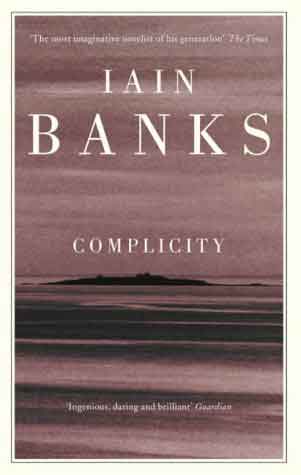
Book Group Review - Complicity by Iain Banks

Complicity is a novel that can be read on two different levels; as a mystery, and as political and social commentary on the Thatcher years. I was somewhat disappointment by the book, because I felt the structure, plot, and narrative of the book was a poor vehicle for the central idea. The novel’s lack of subtlety and control makes one feel bludgeoned over the head with the idealogy behind it.

However to be fair, Complicity still reads as a competent mystery novel, and proves to be stylistically interesting. The choice of using a second person narrative proved to work effectively since it makes the reader complicit in the act of the killing. I felt slightly uncomfortable during those scenes which surprised me because I have read enough thrillers to usually feel desensitized to the violence.

Additionally, I found the last scenes of the book to be memorable as Banks gives us his bleak, nihilistic view of our world. The first to second person switch also makes us aware that while Cameron feels disgusted with his friend’s actions, he nonetheless agrees with the motives and point behind them. Unfortunately I do not have enough expertise on the political environment of the UK during the 80s and early 90s to grasp the finer points of his views, but am highly interested in everyone’s opinions on the political commentary found in Complicity.

To me, the most disappointing thing is that comparatively I know Banks as a far superior author than what he shows in Complicity. Gerald Houghton summarized it best when he reviews the book by stating:

Too often of late Banks seems unable to do justice to his ideas, the intelligence and sophisticated plotting of books like Walking On Glass or the aforementioned The Wasp Factory giving way to a breakneck jokiness that although entertaining enough in itself comes off as lightweight and lazy from the man capable of writing books as driven and purposeful as The Bridge or The Player Of Games.


Iain Banks, is a far better novelist than Complicity would suggest. I highly recommend some of the reading mentioned above especially The Bridge, The Player of Games or Use of Weapons before you write him off.

Musings on The Prestige

You can also find this article here.
WARNING: I would advise anyone who has not watched the movie to do so before reading this review. While I do not give away any major spoilers, there is enough to spoil it for those who have not seen the movie.

I read The Prestige by Christopher Priest when I was a freshman in college. I remember how much I was in love with the book for the first hundred or so pages. How beautifully Priest paved the plot with layers of historical facts, magic, and mystery. It was a brilliant premise, and promised an equally brilliant resolution. It was one of those books that you hope and pray will live up to its own expectations.

Sadly, in this case, it was not to be. Halfway through, I had begun to feel that Priest was writing himself into a box. The Prestige, I felt, was a story that could never have lived up to the promise of its set-up because no one could write a conclusion to match the initial brilliance of the tale.
I stand corrected five years later. Jonathan Nolan, brother of Christopher Nolan the director, has managed to turn the weakest element of the novel - its meandering, anti-climactic plot - into The Prestige’s crowning achievement.

It was fascinating for me, someone who had read The Prestige so long ago, to watch the film for the first time. I went to the theatre with a certain lack of enthusiasm, remembering only vaguely the details of the plot but clearly the strong feeling of disappointment in the conclusion of the book. I also doubted my ability to be truly enthralled by the movie since like other movies such as The Usual Suspects and The Sixth Sense, it seemed The Prestige would depend on what the promos had touted to be its twist ending, which had already been revealed to me by the book.

The reason that propelled me to the movie theatre was a sense of curiosity; I wanted to see what Jonathan and Christopher Nolan could do in their adaptation. After all, the premise was wonderful, the cast was designed to bring in the big bucks — it was only left to be seen whether the plot would take the disappointing turn for the worst as the book had done. Let’s just say that it’s nice to be surprised by a movie. Jonathan Nolan has managed to create a work that can only be described as a loose translation of Priest’s original. The plot has been fine-tuned to play with a level of perfection that was unknown to the novel.

It also didn’t matter that I knew the twists of the movie. In fact, to the observant viewer, Angier’s (Hugh Jackman) secret is revealed early on as he stands in the field of top hats. It dawned on me as I walked out of the theatre elated that the secret to The Prestige, as it was with Memento, (the Nolan brothers' masterpiece to date) is that the while the twist ending is fantastic or exceedingly weird (depending on your tastes), it does not make or break the movie. To use a cliché, the ending is the icing on an exquisitely crafted cake, something that will be apparent on repeated viewings as the viewer’s attention is less focused on what is to come and more on how the magicians got there. Here lies the genius of the Nolan brothers; their path to the ending is littered with subtle hints about both men’s secrets and the sacrifices that are inherent with keeping those secrets.

Therein also lies the emotional impact of the story, something that I am disappointed but not surprised that many critics did not pick up on. You have to be aware of the ending to truly appreciate Borden’s (Christian Bale) apology to Fallon - “Sorry about Sara” - as he is dragged away to be hanged. You have to be aware of the ending to understand the deranged, sacrificial nature of Angier’s triumphant last act in the machine that Tesla makes for him. To sum it up, you have to watch the movie twice to truly see the brilliance of what Jonathan and Christopher Nolan have created.

On a side and purely personal note, if Jonathan Nolan does not win the Oscar for this brilliantly scripted adaptation of the novel, I swear I will never watch the Oscars again.

There remains only one argument to make: The Prestige, both the book and the movie, at the very crux is about obsession. I’m slightly puzzled by those reviewers who have complained that the characters are cold, one-dimensional, and are solely defined by their obsessions. I mean after all, isn’t that the whole point of the movie? It seems to be wish-fulfillment rather than critical evaluation to want warmer, multidimensional characters. It is also an evaluation from those who have only seen the movie once, because I believe the dimensions of Jackman's and Bale’s characters are more apparent in subsequent viewings.

But even if this were not the case, would The Prestige have been a better movie if either man showed other interests or had more love to give to the women in their lives? Yes, if film was a love story or a simple period piece. No, if it is to remain a story of obsession. After all, Angier and Borden are defined by their obsession — they are essentially not the characters that they are without their obsessions. For them to be multi-dimensional (as the reviewers want them) would be superfluous to the movie.Certainly, the characters would have been more likeable if we saw a warmer side, or if they didn’t treat the women they loved badly, or if they sought redemption at the end. But the end goal was not to make the viewer like the characters. It was Nolan’s intention to show you a movie about the destruction of two men by the shared obsession that defines them.

They have to be one-dimensional — obsessed, if you will. Because the question that should be asked is would either one have gone so far if they weren’t exactly like how they were portrayed? Would we have reached the horrific realizations that we do at the end, if the characters were not hell-bent single-mindedly obsessed with destroying each other? The characters as they are shown define the plot. Without these cold, obsessed men, there would be no Prestige. And I think that the Nolans did a damn good job showing the viewer just that.

Monday, October 23, 2006

What I've Been Reading

I have been reading a couple of books for a month now, and after a feel false starts and some books that just put me to sleep, I’m finally back into the grove of things. Let me start with the disappointments. I wasn’t impressed with either Heartbreaking Work of Staggering Genius, or The Curious Incident of The Dog in The Nighttime.

I disliked the two for very different reason. I was aware before beginning Heartbreaking, that many had found the playful introduction too self-referential and sardonic. I happen to enjoy books that can be treated as artifacts, and like authors that have a sense of play. But for the subject matter at hand, Egger’s fictional account of his f*cked up family, the self-referential beginning, and the sarcasm came up as bitter, and uninspired. After 40 pages, I could picture the author one of those self-pitying asshole types, who excuses his whole life because of his dysfunctional family. I know, it’s a snap judgment before I even got to the meat of the book, but I’ve read enough to know that the dysfunctional family thing can be done with grace and subtlety. Like its title, Heartbreaking was just a little too self-aware, a little too much telling and not enough showing. I won’t be trying to finish this anytime soon.

Next comes The Curious Incident of The Dog in The Nighttime, a story narrated from the standpoint of an autistic 15-year-old. I was unimpressed. I admit that the story does take you into the perspective of someone who is autistic, but honestly it all felt too simple, not enough shades of what it means to be seen and treated differently because your brain does not work in the same way as the majority of the population.

Contrary to claims from reviews, I did not feel emotionally connected to Christopher, our autistic protagonist. This may be a matter a personal taste, it may also be a matter of expecting more from what I read if the narrative or the plot isn’t enjoyable. I suspect that many people claim to love this book because it’s an extremely simple read, and it’s about an autistic kid. Having said all this, I have to admit, if you like the concept of a simple story from the eyes of someone autisitc, Haddon does it well… For an interesting piece that asks whether autism is truly a disorder or a different kind of human being, go here. Check back later for more mini summations of what I’m reading.

Tuesday, August 29, 2006

Use of Weapons - Iain M. Banks

Author: Iain M. Banks
Length: 400 pages
Reading time: 1 day
Rating: 5 stars
As a child, I was often a big fan of starting a book that was part of a series because it meant the promise of months and months of reliablely good reads. I read every trilogy, saga, quartet, series that I could get my hands on at the local library.

As an adult, I tend to be suspicious of the series, mostly because the quality and originality dies quickly due to publishing pressure and often-time over indulgent authors *ahem* Robert Jordan. So it is with great pleasure with which I have finished Iain M. Banks, Use of Weapons, knowing that I am standing on the brink of possibly one of the most well-imagined, fast paced series that I have ever had the pleasure of reading.

Use of Weapons is the 3rd of a set of science-fiction novels from the Culture series. Every novel in the series works as a standalone piece, and are related insomuch that they are all stories of the Culture. It is also the best "space-opera" novel I have read since Ender's Game. Certainly Use of Weapons is the more challenging of two, having a unique story structure that may try the lazy reader's patience. However part of the impact of the story comes from such a structure, and anyone who pays attention will quickly figure out how the story evolves. Really, part of the pleasure is figuring it out for yourself.

The premise is relatively simple. The story revolves around a secret agent called Zakalwe who belongs to the Special Circumstances branch of the Culture ( a highly evolved post human society), sent in by the Culture to manipulate backwatered civilizations to what the Culture believes will be the most optimal outcome. Go here to read the back cover blurb.

Although this novel is set in the far futrue and deals with regular space opera fare; spaceships, intergallactic wars, and alien civilizations. I still hesitate to call it science fiction, since I can hear the alarm bells going off in many heads. This is not some hackneyed, formulaic story based on Star Wars. There is something here that any reader will enjoy. In fact many parts of the book read like an modern mystery/espionage novel. The difference is that the book is also incredibly thought-provoking in its entertainment, and manages to raise some excellent question about the value of intervention by a self-appointed superior society to those whom they consider inferior (a topic that has some relevancy in the world today).

At the crux of the novel, Use of Weapons is a close examination of the intricacies of war. The material is emotional, and there is a certain rawness that is exposed as the story progresses. Yet Banks is not humorless in his approach to the topic, writing moments of surprising lightness into this tense novel. While I have showered the novel with praise, I have intentionally revealed very little of the plot. The book is a much more satisfying experience, if it is read without any pre-conceived notions. The reviews online and comments on Amazon give away surprisingly more than I would hope, so be warned. I highly recommend Use of Weapons to anyone.

The book is unfortunately not available on Amazon US (go figure). However there are several mechants that sells copies here and here. I recommend book depository ltd if they have copies. They're highly reliable, and they ship incredibly fast from the UK. I got mine within a week of ordering from them.

Another resource to check is at www.Abebooks.com.

The cheapest prices ranges from 10-14 dollars including shipping.

Wednesday, August 02, 2006

A Discussion of Two Hearts (sequel to The Last Unicorn) by Peter S. Beagle


I finally restored this, thank goodness for David and Technorati.
The Last Unicorn has always been near and dear to my heart. I first discovered it in its animated form as a child and was touched by the magic of the story and the beauty of the music that accompanied the film. It was not until very much later, well into college, that I discovered the book itself by Peter S. Beagle. The book was as touching to me as an adult as the movie had been to me as a child.

So when I discovered that Beagle had penned a sequel (actually they’re calling it a coda, those clever marketers), Two Hearts, I was absolutely delighted. Two Hearts (nominated for a Hugo this year) is a novelette (longer than a short story, shorter than a novel) set in the universe of The Last Unicorn. It takes place many years after the original story but brings back the four main characters of The Last Unicorn. For many years Beagle had refused to write a sequel to his beloved story, believing The Last Unicorn was a stand alone novel that told everything that needed to be told of the story.

[Spoiler alert] (If you have not read the sequel, please do so before reading on. Below are links to for buying the novelette)

Before the Hugo awards are announced (at the end of August), you can find a free version of it at: http://www.sfsite.com/fsf/fiction/pe01.htm.

However if you want to have your own copy, there are currently two ways of obtaining one.

One is by going to: http://www.conlanpress.com/html/books.html and buying the audio file of The Last Unicorn. A hardcover limited version signed by the author comes as a gift to the first 3000 customers. If you want this version, the ONLY way to get it is by buying the audio file of The Last Unicorn

The other is by going to Amazon and buying The Line Between, Peter S. Beagle's new collection of stories, Two Hearts is one of them.


After reading Two Hearts, I am not sure what to think, I do not know what I was looking for in the sequel. As Beagle claims, The Last Unicorn ended where it did because it had come to its natural and (to me) perfect conclusion.

First the things I had a problem with, I did not like that in Two Hearts, the unicorn is addressed as Amalthea (at one point Smendrick even goes so far as to claim that it is her name). Those familiar with The Last Unicorn will remember that Smendrick called the unicorn Lady Almalthea to fool King Haggart. The unicorn was ALWAYS referenced as she or the unicorn to the reader. This is not just simple quibbling on my part. I believed that Beagle kept the unicorn nameless intentionally. It separated her from her companions; a way of reminding the audience of her true nature and her inability to be one of them. Calling her Amalthea in the coda I found untrue to the original.

I also found the killing of the griffin to be a slightly disenchanting scene. The griffin felt incredibly one-dimensional--- more plot device than creature--- as the force that set the story in motion and took it to its natural end. This was surprising because Beagle has always managed to give personality and depth to his creatures. The harpy and the Red Bull of The Last Unicorn both felt more real to me than the griffin in Two Hearts.

However this is not to say that Two Hearts failed as a continuation of The Last Unicorn, Two Hearts is a beautiful story. Especially for those who have read The Last Unicorn. It was surprising how strongly I must’ve felt about the story, and of the relationships, because at the first mention of Lir and the unicorn, I teared up in a way that surprised me. After all it had been many years since I had read the original. This effect is no doubt due to the mastery of the author.

Beagle’s voice stays true to the original, and the characters are very much the same, older but in no way altered to fit a new story. While The Last Unicorn was a story distinctly written by a young man, Two Hearts is no less distinctly a work of an older man. Between its pages, Beagle manages to address his own mortality.

Perhaps this is why it startles me. The Last Unicorn, while tragic, ends on a beautifully heroic note. The hero bereft of his love, rides of into the distance. Yet there is always hope…because he determines to remember her, to honor her, and to wait for her. In Two Hearts, age has paled everything and turned the rest to dust. It is no longer only a tale of a highly romantic and honorable love; it is also a tale of a man, once young, now old. I do not think I loved Two Hearts in the same way that I loved The Last Unicorn. However, as I become older, I’m also not sure that I will not grow to love it. I think only time will give me that answer.

Wednesday, July 05, 2006

Vile Bodies and Never Let Me Go

I’m currently reading two books (both for book groups): Vile Bodies by Evelyn Waugh, and Never Let Me Go by Kazuo Ishiguro. The first is a satirical look at the London “smart set” of the 1930s. While I want to hold judgment until the end, I have to say satirical works about one era or another usually do not appeal to me (The whole body of writings by Kurt Vonnegut, and Joseph Heller’s Catch-22 being the exceptions)

I’m uncomfortable with authors who “use” the novel as a device to push one singular idea across. I understand that many of our considered classics use this form, however often I feel the idea takes over the novel blanching out the characters and plots in sole service of that one thing the author want his whole novel to be all about. And characters suffer as a result, having no developed personality or acting in ways that make no sense in relation to their personality. Vile Bodies suffers from this. Rather than displaying the decadence and demoralization of an era through real and complicated characters as Edith Wharton does in House of Mirth, Evelyn Waugh creates a novel that has no interesting characters, just caricatures. Anyways, it’s stuffy reading. But we will see.

The second book looks to be more promising. Kazuo Ishiguro evokes the same feelings I had when I was reading Cat’s Eye by Margaret Atwood. Never Let Me Go is a story spent on reminiscing, of childhood, of friendship, and of things that are boiling under the surface. Kathy, Ruth, and Tommy go to a private boarding school called Halisham somewhere in England. The book serves as a memoir to their relationships, and the knowledge that there is something special about the children of Halisham. As Kathy and the rest grows older, ever aware of their specialness, they must come to grips with their lives and the meaning behind them.

I am not going to give away the plot, although you can’t escape it if you’ve ever heard of the book. What’s with reviewers these days? If you look at almost any of the reviews about this book, you’ll see the plot that takes the author 2/3rds of the book to slowly unravel completely revealed in the first couple of sentences. As if today’s readers can’t be bothered to discover what lies within a book’s covers without someone else rehashing it for them first.

If you don’t know the book’s premise, I advise you to pick it up without looking online at reviews. It’s a fast read, and it’s better if things dawn on you as you read the book. This is a book about the potential of our world, and the devastating effects it will have on future generations (err I was just told that that's not what the novel is about at all, and I'd have to agree after some things were pointed out to me, so I will have to say that the novel is really about uhm humanity---keeping it broad to save myself more embarassment down the road). Kazuo Ishiguro is also famous for The Remains of the Day.